
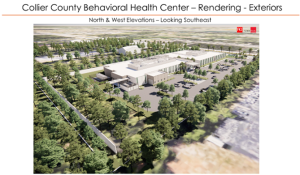
During the Board discussion regarding the David Lawrence Center Operating Agreement and Naming Rights Agreement on May 27, 2025, Board members requested that any outstanding issues be identified prior to the final discussion on this topic scheduled for June 10, 2025.
The following narrative identifies issues raised repeatedly by the Clerk of Courts and Comptroller throughout the discussion regarding the Central Receiving Facility and focused in the following areas:
- Cost of Facility and Number of Beds
- Funding of Central Receiving Facility Operating Costs
- Naming Rights
Cost of Facility and Number of Beds
A need for mental health services in Collier County was identified and voters supported $25M for a 130-bed facility with operating and maintenance costs to be borne by David Lawrence Center (DLC) as detailed in Project Fact Sheets during the Infrastructure Sales Tax campaign.
The following table compares the following:
- the initially scoped facility with capacity for 130+/- crisis treatment beds,
- the original 120-bed facility outlined in the Jacobs Engineering Group feasibility study, and
- the currently planned 87 bed Mental Health Facility.

Over time, total project costs have grown to $56.1M for the construction of an 87-bed facility. This equates to a per bed cost of $644,828.
Despite multiple discussions regarding the number of new beds available, there is still confusion as to the correct figure due to numerous existing facilities and services.
Funding of Central Receiving Facility Operating Costs
The original intent for the David Lawrence Center to cover operating costs has diminished to a commitment to fundraise, but any shortfalls seem expected to be funded by the taxpayers over the 30-year lease period. The most current pro-forma submitted by the David Lawrence Center reflects a Year 1 operating loss of $730,080 that grows to $1,619,635 in subsequent years. The total projected operating loss over the 30-year lease term amounts to $45,886,506.
The current Terms of Operating Central Receiving Facility in the Funding Category state the following:
- FUNDING. With the exception of the County’s maintenance obligations of the CRF as set forth in Section 11 of the Lease as well as local match funding requirements established under F.S. 394.76(9)(a), it is understood and agreed that any funding by Collier County for construction of the CRF is not operational funding. David Lawrence shall also seek operational funding from other sources, including, but not limited to, excess proceeds generated by the Naming Rights Agreement, as applicable, and governmental funding sources such as grants and Medicaid reimbursement, for operation of the CRF. It is understood and agreed by the parties that the projected revenues to operate the CRF include the current levels of Federal, State and Collier County government funding. If sources of revenue for operation of the CRF from the Federal Government, State Government or Collier County are reduced, DLC may submit a request for deficit operational funding of the CRF to the County. The request must be accompanied by correspondence by DLC requesting financial support for operation of the CRF from the participating hospital system(s), municipalities in Collier County, philanthropic organizations which have previously pledged funding commitments for operation of the CRF, and the local school district, and the stakeholder’s response, if any, received within 30 days of the date of DLC’s correspondence. The County Manager will present the funding request to the Board of County Commissioners as soon as reasonably practical, and the Board of County Commissioners may (1) approve and fund the amount requested, (2) allow for an adjustment to the level of services proportionate to actual revenue until such time as governmental funding resumes to prior levels to enable a full-service operation, or (3) disapprove both the funding request and adjustment in level of service (“Terminatable Event 2”), in which case the provisions of Section 25 of this Agreement shall apply.
The above clause reportedly limits the Board’s potential exposure for assuming operating costs of the Central Receiving Facility but it’s unclear how this limits exposure. Under current DOGE scenarios, there could be negative impacts to federal and/or state funding levels for mental health services. DLC could then request deficit funding from the BCC. If not approved, DLC would have the right to reduce services or initiate the Termination provisions in the agreement. This could result in the Board having a $56.1M building that is located adjacent to the DLC campus without operational services. The potential financial liability that could fall back on taxpayers is unlimited.
Naming Rights
The Naming Rights Agreement states that funds received for naming a space within the Central Receiving Facility (CRF) will be initially channeled to fund Furniture, Fixtures, and Equipment (FF&E) and any residual funds will then be used to offset operating costs of the facility, rather than offsetting any portion of taxpayer-supported costs of construction.
It is presumed that named facilities would be for an extended term (i.e., 10 years or greater). If naming rights donations are paid out over an extended period, rather than as a lump sum one time contribution, this will further restrict available cash flow from naming rights.
Another issue with the Naming Rights Agreement is the number of additional David Lawrence facilities (currently 6, and 2 pending with current pledges of $4M and $10M) located in Collier County. In effect, the Central Receiving Facility is in direct competition with other DLC facilities that have potential assignment of naming rights. As the CRF is a facility for Baker Act and Marchman Act involuntary admissions, the desirability of this facility to potential donors may be somewhat limited. Other David Lawrence facilities that address issues such as children’s mental health needs may have a greater appeal for potential donors. The Naming Rights agreement gives DLC the total authority to solicit and allocate philanthropic funds with no requirement to prioritize CRF needs nor goals that must be achieved.
