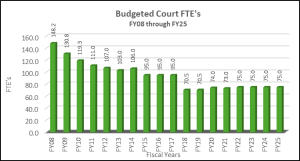
When you see the numbers, you may wonder how we managed to keep up with the workload despite court budget reductions. It wasn’t easy. We had to carefully examine every process to ensure it was as efficient as possible. Even small improvements such as saving just one minute on a task added up to make a real difference. Below are some of the steps we took to streamline our work, meet performance standards, and most importantly, continue serving the citizens of Collier County.

We looked for a better court computer system, one that went beyond basic docket entry and state reporting. Most systems relied on numeric codes, but we preferred more detail be used so our clerks would not need to look through code lists to enter information. In 2003, we partnered with a startup, Aptitude Solutions (now Equivant), that was willing to build a more user-friendly and comprehensive system for all court users.
Showcase was developed with input from court clerks to help us meet performance goals while working with fewer staff. The goal was to make the system work for us by simplifying and streamlining processes. We created a feature called Smart Docketing to automate repetitive tasks. For example, when an attorney files a Notice of Appearance, clerks would normally have to update several parts of the system—docket the filing, add the attorney to the case, enter a not guilty plea, possibly change a court date, and send a copy of the charging document. With Smart Docketing, the clerk enters the filing once, and the system prompts for any needed information, then updates all necessary areas automatically—even emailing the charging document to the attorney.
We also added fields to help the system make decisions. For instance, we included the date of service and the date an answer was filed, so the system could later determine whether a default should be issued.
Automation in the traffic citation area allowed us to reduce staff. We built the system to guide clerks through the options available to each person who received a citation. Once an option was selected, the system handled the rest—updating dispositions, adjusting fees, scheduling court dates, tracking case events, sending information to the Department of Highway Safety and Motor Vehicles, and clearing suspensions. We also implemented eCitations, which allowed law enforcement to submit citations electronically. This eliminated duplicate data entry and significantly sped up processing time.
We automated in-court processing so that clerks could enter dispositions directly into the system in real time. This eliminated delays in sharing information with the jail and other court offices. Previously, the jail had to wait until the end of the docket before releasing individuals. Now, with real-time updates, the disposition is available immediately, and the clerk’s work is complete by the time they leave the courtroom. Over time, this efficiency allowed us to reduce the number of clerks per proceeding from two to one. The system automatically generates notices, judgment and sentence forms, and emails them to attorneys and any relevant agencies.
Another vital function of the Clerk’s Office is managing the juror process, a cornerstone of the American judicial system. Recognizing the need for modernization, the Clerk’s Office recently implemented the Tyler Jury Management System, a robust platform that has significantly enhanced operational efficiency. This advanced system reduces manual data entry, automates key processes, and offers seamless online integration for jurors, making it easier for residents to respond to jury summons, update personal information, and request deferments. The new system has not only improved internal workflows but has also enhanced the overall experience for citizens serving their civic duty.
In addition to developing a top-of-the-line computer system, we worked closely with judges and other court agencies. Their cooperation was essential to automating so many areas. These changes were significant and required everyone in the court system to learn new processes and adapt to new ways of working. Our goal was not only to improve Clerk operations but also to support and streamline the work of our partner agencies.
For a full list of services, please visit our Courts page: Court Divisions – Collier Clerk of the Circuit Court & Comptroller